


Last week, I was talking to an author mastermind about what I think makes a Substack successful. I’ve been experimenting here for two years, and I’m learning new things all the time. But the building blocks of strong writing are the same things that keep you engaged with someone’s newsletter.
To mark the occasion, I came up with a few things that I think make the difference between “another newsletter” and “I’ll save that one to read later over tea.”
1) Know the value you’re giving your reader beyond your writing.
And make it super clear to them. When I’ve got my copywriter crown on, I call it your unique selling point or unique value prop.
Great writing is valuable here, and there’s an awful lot of it so that in itself won’t necessarily stand out. Be clear about what you’re offering your readers that’s distinctly different from everyone else and tell them why you care so much.
You ought to be able to spell that out in a couple of sentences and put it in your publication bio and on your About page.
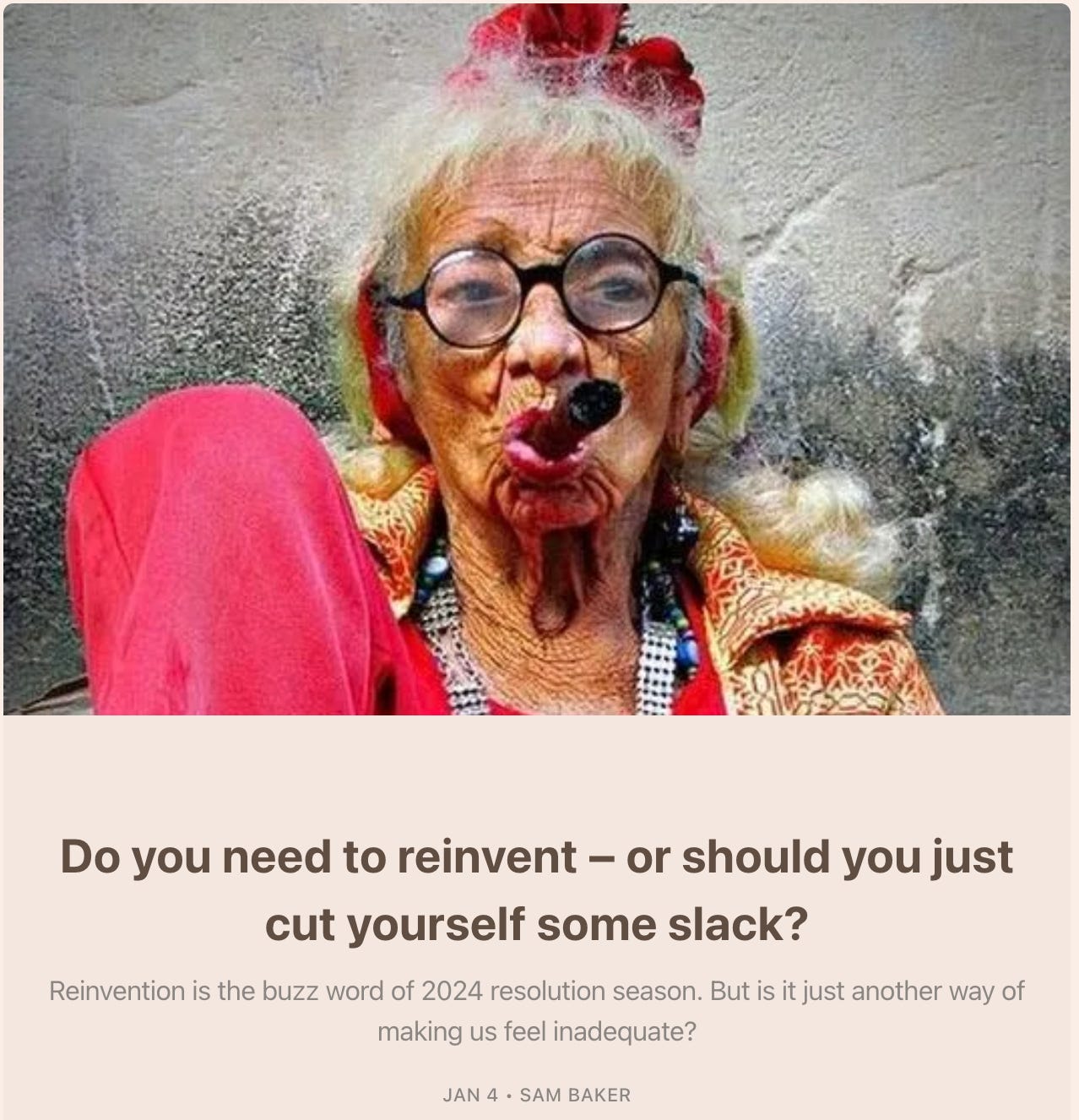
I’m slightly obsessed with The Shift With Sam Baker (That’ll tell you a lot about where I’m at – she’s so damn funny.) The Substack evolved out of her podcast (with the same name) that launched in 2020.
She sums it up with three sentences:
Women don’t vanish after 40. Who knew?! Amplifying and celebrating the voices of women in midlife and beyond by the former editor of Red, Cosmopolitan (and Just 17!).
Then her About page gives you the bigger story:
“Can you feel The Shift?
After many years of editing women’s magazines (Cosmo, Red, Company, Just Seventeen (RIP), I sat back and looked around one day, and thought “WTF?!” I mean, seriously. Where had all the older women gone? And by older, I don’t mean “older”, I just mean not 25. You could count the number of us getting airtime on one hand…
So I decided to do something about it…I want to give women far and wide a safe space where we can talk about the things that matter. That’s why The Shift is now here on Substack.”
She’s got a strong value proposition and a unique point of view.
Which is why I subscribed and now I save her articles on my phone to scroll through them with a cup of tea in my favorite swinging egg chair.

2) Have a unique point of view
When I think about a unique point of view, I picture a pair of invisible glasses you wear to see the world.
The prescription of your lenses is determined by all the love, pain, suffering, adventure, neglect, laughter, grief, serendipity, anger, and joy you’ve experienced. The full range of your emotional experiences is what dials in the prescription of your lenses. And it changes as we age, experience more, and grow older and wiser.
So the writers who inspire me the most are not only excellent at their craft, they can also give us glimpses into how they see the world.
Most of us are using writing as a method to figure out how we feel as we try to untangle the messiness of being human. A bit like cleaning your glasses with a soft cloth. (Knowing that in a day or two, they could get foggy again.)
That’s what Kathryn Vercillo does with her Substack, Create Me Free.
She could say “I write about the impact of art therapy on mental health.” Instead, she helps us put on her prescription lenses in her bio:
“Writing about the complex relationship between art and mental health, not just art as therapy, but also the myriad ways mental health symptoms impact artistic process, content, medium, and productivity.”
She helps artists with mental health challenges better understand their situation so they can thrive creatively, financially, and psychologically. You’ll find interviews and research she’s done in creating a body of work that explores this idea from all different angles. She also looks at the times when creativity aggravates mental health symptoms.
So if you’re an artist who feels most creative and artistic advice is one-size-fits-all, are you going to go to Google… or Kathryn?
She understands exactly who her reader is, which brings me to…
3) Get to know your reader
Remember back to point 1 where I said great writing means writing about things you care about?
On Substack you’re also writing for a (paying) reader. Which is an infinitely exciting (and often daunting) part of writing here.
Because at its core, that’s what Substack is: a place for readers and writers to connect. To have a more real, honest, and immediate conversation.
And that involves comments, likes, and shares. (Which invites its brothers and sisters comparison, fear, and FOMO.)
So when you’re just starting and those things aren’t there, it triggers a lot of feelings… (We all go through it.) And when people do comment, like, and share, that triggers other — just as strong feelings.
Yet, isn’t that part of the whole mishegas of this experiment?
I can scratch an itch about a subject through the lens of my life experience, and you feel something. It resonates. It makes you laugh. Then you and I can have a little back-and-forth about it.
You click that little heart to raise your hand and say, “Yes please, more of that dear writer.”
4) So many growth opportunities here as a writer
When I started this 2 years ago, I was working full-time for Scribe Media as a copywriter building a team to help authors launch their online platforms. This was an experiment around two things:
To answer the question from authors, “What about Substack – should I be writing there?” (I had no idea so I hopped on here to try and figure it out)
A place to bring my writing circles back to life
Two years later, the first Scribbling Circles are on the calendar for Saturday, 1/27, and Sunday 1/28, so please come check them out. (Details at the end of the post.)
The Scribe job is over but I’m still here with you. It feels almost playful to establish my writing practice in such close proximity to amazing writers like Elizabeth Gilbert and George Saunders. (Who knows what’s possible 🤯.) BTW — Highly recommend Gilbert’s Letters From Love.
This ecosystem and my consistency are helping me grow as a writer.
So thank you. Because even if I haven’t mastered the art of engaging in a scintillating conversation in the comments, let’s have a bit of faith in each other that’ll happen.
I’ve learned what moves the needle on my craft is reading great writers while consistently writing for readers. This whole “situation” surprises and delights me when I look at it through that lens.
So I hope many of you stick around here for another two years (at least!) and we keep on keeping on together.
Writer to reader. Reader to writer.
I’m curious, what’s one thing that has surprised and delighted you here on Substack? Wanna have a ‘lil back-and-forth below??
And if you’re thinking about coming to one of the Scribbling Circles how about dropping a note about which one in the comments too? 🙏🏻
Stay creative,
Jen
P.S. The deets for next weekend’s writing circles. Mark your calendar!
Here are the links and I’ll send out day of reminders.
Saturday, January 27 · 4:30 – 6:30pm CST / 2:30-4:30 PST
Saturday Scribbling Circle Link
Sunday, January 28th· 2:00 – 4:00pm CST | 12:00 pm - 2pm PST
Sunday Scribbling Circle Link
Found you via @Sarah Fay and this article is full of helpful nuggets for those of us writing on Substack, thank you. (And I'm a big fan of @sam baker's newsletter and podcast too!
Fab tips, thank you! Can’t beat a photo of Iris Apfel to make me smile 😊.