



Last week I was reading the Writing in the Dark Substack by Jeannine Ouellette (highly recommend) and someone wrote to her for advice. The writer’s vulnerability about her sense of emptiness around the holidays really got me thinking.
This was just before Thanksgiving and she said, “…here we are, the darkness and days spiraling in on themselves, the holiday season winding up, and I am just so tired. Even though I have always been a holiday person…I can barely muster the energy this year.”
Then, eavesdropping on strangers at Merit Coffee a few days later (as I love to do), a woman at the table next to me said almost the same thing.
I know everyone’s story is different. And many of us feel this way during the holidays. But lately, I’ve noticed underlying feelings of resentment and hopelessness under the words. A deep sadness that I can’t ignore, yet I’m afraid to acknowledge it out loud.
Our nervous systems have been in overdrive since the early days of the pandemic. It’s like we don’t understand how to address this bone-deep sense of anxiety-fueled exhaustion.
Since the holidays have traditionally been a difficult time of year for me with my personal family dynamics, I’ve experimented with LOTS of different things during this time of year.
Just to give you a sense of the variety, I’ve:
👉🏼 Showed up for everyone and been toxically positive
👉🏼 Showed up for everything and been guarded and sarcastic
👉🏼 Done a meditation retreat
👉🏼 Spent it shaking at an Ashram in Bali (my favorite so far)
👉🏼 Spent it with friends who are chosen family
So I want to suggest using writing to help shift your attitude. And because I’m also feeling heavy and tired this holiday season, I’m suggesting a little comic relief.
How about writing a better story for yourself? Let’s use writing as a path to more self-compassion.
As Elle Luna says, “Your story is your power.”
Anyone who’s dabbled in therapy or life coaching knows how important an hour of talking about ourselves can be. Writing about chapters of your life is not only the cheapest form of therapy, there’s also research that shows it increases self-esteem.
And if you really want to dip your quill in the inkwell, writing about yourself in the 3rd person is even more bounce to the ounce. It’s a technique that helps change the narrative about your past. (Ask any memoir author out there.)
A few simple reasons why it works so well:
You get to make your own meaning out of life's challenges and struggles
Studies show that people are more positive about themselves when they’re writing in the 3rd person
We can be kinder and more compassionate about others than we can about ourselves
When you give yourself permission to view your life through another character's eyes, you can recognize how much you’ve grown. You realize important connections that can only be seen with reflection afterward.
And you’ll be gentler on yourself.
Try changing your perspective about one small area of your life.
Here’s a simple suggestion for rewriting this year’s holiday story:
✒️ Make yourself a character from a holiday past where you wish it had gone differently. Maybe you didn’t know how to say “no” enough and you were totally drained by the end. Or your socially-alcoholic Uncle Donald wouldn’t stop teasing your son and you never spoke up for your little kiddo.
Whatever it was, write about it in the 3rd person. And then create a comedic turn of events that has it end on a completely different note.
Have yourself step in with some witty or sarcastic one-liner that completely breaks the tension and makes you the hero of the story.
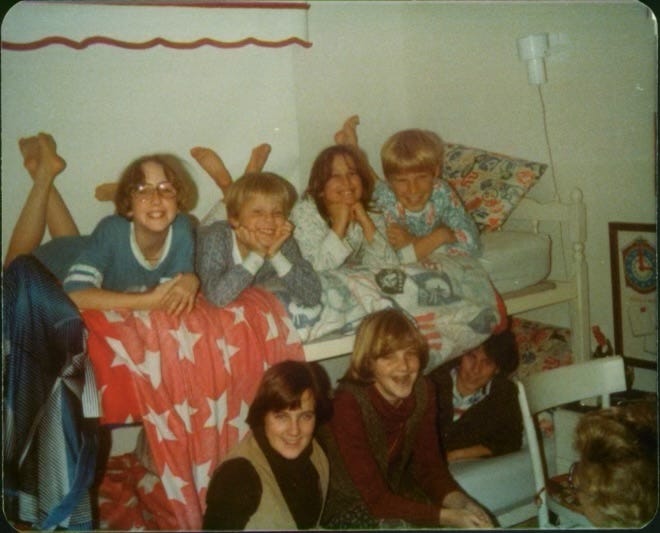
Set a timer, don’t overthink it, and make yourself laugh. (Preferably at someone else’s expense. 🤣)
Laughter is the best medicine.
Let me know how it goes…
Sharing this post helps new readers find me. If you enjoyed this, please share. It means so much.
Love this and totally believe it’s within our power to flip the script on the same old played-out narratives. I prefer to not revisit the past and would rather envision the perfect future, but I think Eckhart Tolle would say that, too, is the wrong approach. Embrace the now and let go of the past wrongs and the future expectations.